
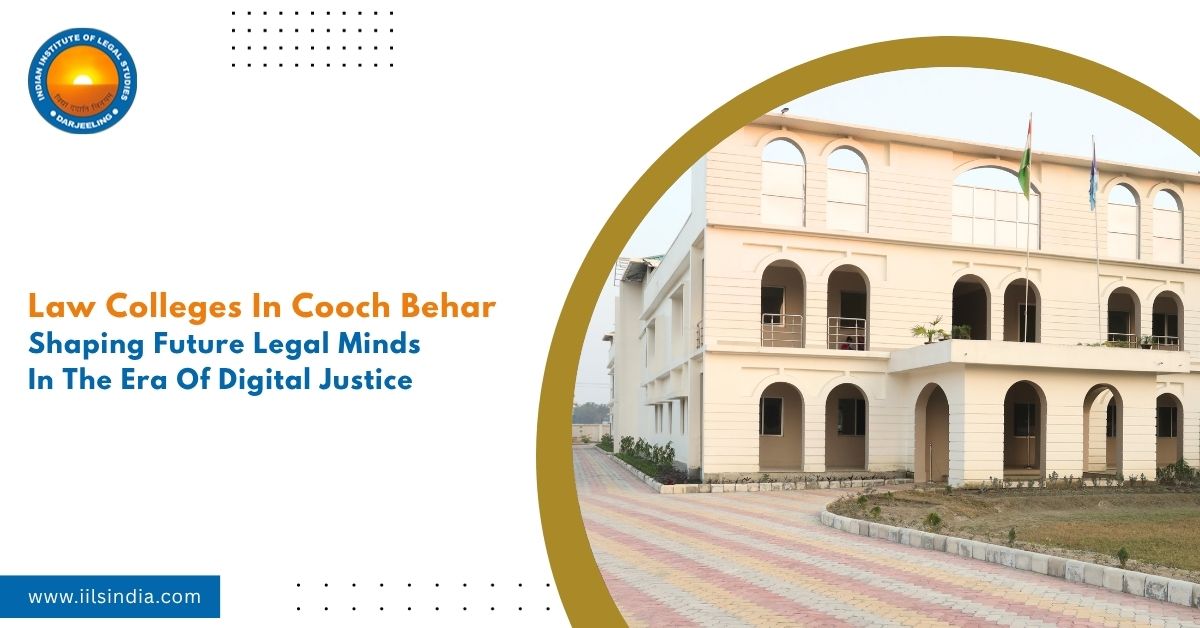
In order to uphold justice, defend rights, and guarantee the rule of law in society, the legal profession is essential. Every competent attorney, judge, legal counsel, or human rights advocate has a solid background in legal education. Cooch Behar, a historic district in West Bengal, has been a major hub for legal education in recent years, providing prospective law students with possibilities to pursue high-quality legal studies while advancing society’s legal development.
Law schools in Cooch Behar are not only teaching traditional legal principles but also preparing students to deal with modern issues like cybercrime, data protection, digital privacy, and online consumer protection as India experiences rapid technological advancements and growing legal challenges in the digital world.
The Growth of Legal Education in Cooch Behar
Law schools in Cooch Behar are not only teaching traditional legal principles but also preparing students to deal with modern issues like cybercrime, data protection, digital privacy, and online consumer protection as India experiences rapid technological advancements and growing legal challenges in the digital world.
The emphasis that Cooch Behar’s legal institutions place on community involvement is one of their major contributions. Students are exposed to real-world legal challenges that impact regular people through legal assistance camps, awareness initiatives, moot court competitions, seminars, and workshops. These programs help close the knowledge gap between classroom instruction and practical legal issues.
Since many people in rural and semi-urban areas are frequently unaware of their legal rights, legal education has become especially important in Cooch Behar. In order to help people comprehend issues pertaining to consumer rights, women’s rights, child protection laws, environmental laws, and access to justice, law students and faculty members often take part in legal literacy initiatives.
The Relevance of Legal Education in the Digital Age
Unprecedented technological change has occurred in the twenty-first century. The way people live and interact has been altered by smartphones, social media, internet banking, e-commerce, and artificial intelligence. But these changes have also created new legal issues.
Identity theft, hacking, phishing scams, cyber fraud, online harassment, and data breaches have all become widespread issues. Numerous statistics state that cybercrimes in India are getting worse every year, impacting people, companies, and governmental organizations. This shifting environment emphasizes how crucial legal education is becoming.
Cooch Behar law schools have a big part to play in training future attorneys who can handle these difficulties. Institutions contribute to the development of lawyers who can meet the demands of a technologically advanced society by exposing students to current legal concerns.
Cyber Law: A Contemporary Legal Challenge
Cyber law is one of the many new legal domains that merits particular consideration. The legal framework that regulates acts carried out via computers, digital networks, and the internet is known as cyber law. The Information Technology Act, 2000 and pertinent sections of the Bharatiya Nyaya Sanhita (BNS), 2023 are the main laws that govern cyber-related offenses in India.
Citizens are becoming more susceptible to online crimes due to the growing usage of digital platforms. Financial frauds, social media impersonation, phony investment schemes, fraudulent calls, and cyberstalking have become commonplace issues. Many victims are still ignorant of their reporting options and legal recourse.
Cyber law-trained law students can make a substantial contribution to solving these problems. They can support victims, raise awareness of digital safety, and push for more robust legislative safeguards. Future attorneys can contribute to the development of laws that strike a balance between the advancement of technology and the defense of fundamental rights through study and legal education.
Legal Aid and Social Responsibility
The focus on social responsibility and legal aid is a key component of Cooch Behar’s legal education. Legal education seeks to develop professionals who are socially concerned in addition to courtroom advocates.
Legal awareness initiatives are organized by numerous law schools in local communities, villages, and schools. Child rights, women’s rights, preventing child labor, cyber safety, consumer protection, and constitutional rights are often discussed topics. By making legal knowledge available to everyone, such programs empower citizens.
Article 39A of the Indian Constitution, which encourages equal access to justice, is the foundation for the idea of legal aid. Participating in legal assistance activities allows law students to serve a significant social goal while gaining real-world experience. They discover that the law is a vehicle for social change in addition to being a vocation.
The future generation of legal professionals is being shaped in large part by Cooch Behar’s law schools. These institutions make a substantial contribution to the advancement of justice and legal awareness by fusing academic brilliance with hands-on training and social engagement.
Legal education must change to accommodate new issues like cybercrime and digital rights in a time of digital transition and complicated legal challenges. Future attorneys who receive training at Cooch Behar have the opportunity to advance the rule of law and increase access to justice in society in addition to achieving professional success.
The significance of legal education will only increase as technology continues to change the world, making Cooch Behar law schools crucial establishments for creating a society that is accountable, just, and knowledgeable about the law.
